
Geotextiles in Dike Reinforcement: A Sustainable Solution for Climate-Resilient Flood Protection
Published: August 2026 | Category: Industry News | Reading Time: 4 min
The Growing Challenge of Flood Protection
As climate change intensifies, coastal and riverine communities worldwide face an urgent challenge: strengthening flood defense infrastructure to withstand rising sea levels, more frequent storm surges, and increasingly unpredictable weather patterns. Nowhere is this challenge more acute than in the Netherlands, where approximately 1,500 kilometers of dikes require raising and strengthening to address these climate-driven threats.
Traditional dike reinforcement methods—excavating and replacing soil, importing rock armor, and constructing massive earthworks—are expensive, resource-intensive, and environmentally disruptive. The extraction and transport of millions of tons of stone and soil generate significant carbon emissions, while the construction process itself can damage local ecosystems and disrupt communities.
But a more sustainable approach is emerging. Geotextiles are proving to be a game-changer in dike reinforcement, offering a combination of cost-effectiveness, environmental sustainability, and engineering performance that traditional methods cannot match.
The Sustainable Dike Revolution
Across Europe and beyond, engineers are increasingly turning to geotextile solutions for dike reinforcement and flood protection. The benefits are compelling:
1. Replacing Rock with Geotextile Tubes
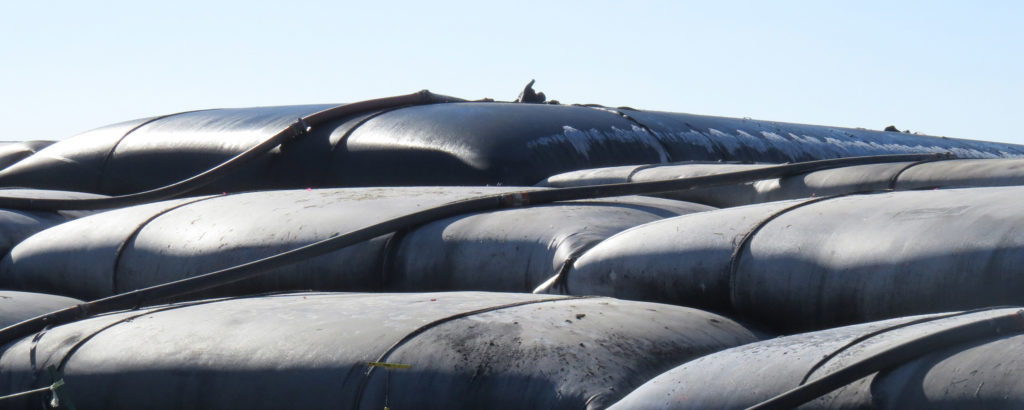
One of the most significant innovations is the use of geotextile tubes—large, tubular containers fabricated from high-strength geotextile fabrics. These tubes are hydraulically filled with locally available sand or dredged sediment, creating durable, erosion-resistant structures that can replace traditional rockfill berms.
A notable example comes from South Korea, where a polder dike was constructed using a sand-filled geotextile core with a rock revetment, instead of a traditional rock-filled berm. The result: reduced costs, saved construction time, and a significantly smaller carbon footprint.
Similarly, in Germany, the HUESKER Group pioneered the use of geotextile sand containers in coastal protection with a dike project at the Ruestersieler Watt in Wilhelmshaven. These multifunctional, heavyweight elements are now used in the construction of breakwaters, groins, dams, and dikes worldwide.
2. Vertical Geotextiles: Stopping Piping Before It Starts
“Piping”—the internal erosion of soil particles through a dike or levee—is one of the most dangerous failure mechanisms in flood defense. Water seeping through the foundation can gradually wash away soil, creating underground channels that can lead to sudden, catastrophic collapse.
A groundbreaking experiment at the IJkdijk test facility in the Netherlands proved that geotextile positioned vertically in a dike can stop piping. The “GeoDetect filter and detection system,” supplied by Ten Cate Geosynthetics, was installed over a width of 15 meters and a height of 0.5 meter in the clay layer of the dike.
The innovation earned the Rivierenland Water Board the Water Innovation Award 2013 in the “Dry Feet” category. The vertical sand-tight geotextile allows water to pass through while holding back soil particles, effectively eliminating the need for a minimum seepage path length to ensure dike stability.
In practice, this means dikes can be reinforced without massive widening. The Rivierenland Water Board subsequently contracted the installation of geotextile along the inner berm of dikes near both Ingen and Rijswijk as an alternative to conventional dike upgrade methods. A total of 2,100 meters of geotextile was needed for four locations between Hogestein and Opheusden.
3. Erosion Protection with Lower Environmental Impact
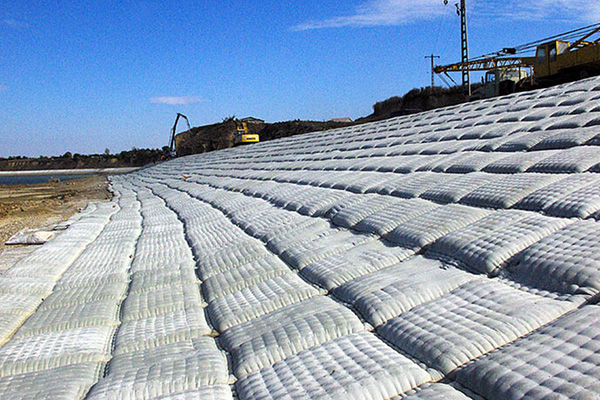
Geotextiles also provide superior erosion protection for dike slopes. Nonwoven geotextile filters can be used both around landside gravel drains and under the riprap protecting the upper portion of riverside slopes. The geotextile package protects the filling material from internal and external erosion, preventing dike breaching due to overflow or piping.
This erosion protection enables steeper slopes, which in turn reduces the amount of filling material required and minimizes land consumption. Requirements for filling materials are also lower, allowing the use of locally available soils rather than imported materials
4. Green Dikes: Combining Safety with Ecology
Perhaps the most exciting development is the concept of the “green dike”—a reinforced structure that also supports biodiversity and natural ecosystems.
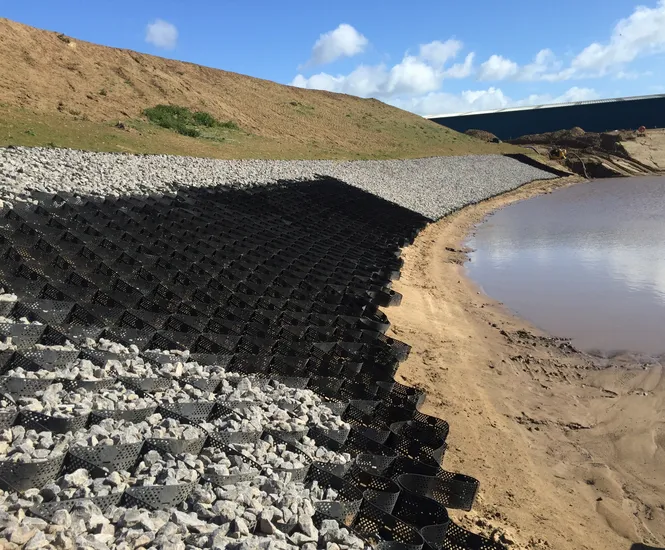
In the Marken Dike Reinforcement project in the Netherlands, Rijkswaterstaat deliberately chose to reuse the old basalt revetment, demonstrating a commitment to circular economy principles. A geotextile is laid down with a layer of coarse gravel as part of the reinforcement work. Additionally, a geotextile eco-grid was installed on the dike to protect vulnerable animal species, such as grass snakes, keeping them safely out of the work zone.
Research is also exploring whether dredging sludge can be used to develop green, strong, and biodiverse dike revetments. The “Growing Dike” consortium in the Netherlands is conducting pilot experiments using dredged sediment for dike reinforcement, contributing to circular economy and flood protection initiatives.
Environmental and Economic Benefits
The advantages of geotextile-based dike reinforcement extend far beyond engineering performance:
Environmental Benefits
-
Reduced carbon footprint: Replacing rockfill with locally sourced sand or sediment eliminates long-distance transport of heavy materials
-
Lower land consumption: Steeper slopes mean less land area is required for dike construction
-
Ecosystem protection: Geotextile eco-grids protect vulnerable species during construction
-
Circular economy: Dredged sediment and reused materials can be incorporated into dike construction
-
Biodiversity support: Green dikes can support native vegetation and wildlife
Economic Benefits
-
Lower material costs: Locally available fill materials are cheaper than imported rock
-
Faster construction: Geotextile installation is quicker than traditional earthworks
-
Reduced land acquisition costs: Smaller footprint means less land to purchase or compensate
-
Extended design life: Geotextile filters and erosion control systems are designed for 50-year service life
-
Lower maintenance: Properly designed geotextile systems require less ongoing maintenance
What This Means for the Industry
The growing adoption of geotextiles in dike reinforcement represents a fundamental shift in how the civil engineering industry approaches flood protection. Key takeaways for engineers, contractors, and procurement professionals:
-
Geotextiles are no longer just a “supplement” to traditional methods—they are increasingly the primary solution for dike reinforcement projects.
-
Sustainability is becoming a core requirement, not just a nice-to-have. Projects that demonstrate environmental responsibility are more likely to secure funding and regulatory approval.
-
Innovation is accelerating. From vertical geotextiles for piping control to geotextile sand containers for coastal protection, new applications are emerging rapidly.
-
Long-term performance is proven. Nonwoven geotextiles used in dike revetments are designed to function for at least 50 years, demonstrating the durability and reliability of these materials.
Conclusion
As climate change drives the need for more resilient flood protection infrastructure, geotextiles are emerging as a cornerstone of sustainable dike reinforcement. From replacing rockfill with geotextile tubes to stopping piping with vertical geotextile barriers, these versatile materials deliver engineering excellence, environmental responsibility, and economic efficiency.
The Netherlands—a country with centuries of experience in water management—is leading the way, but the lessons are applicable worldwide. For engineers and project owners facing the challenge of upgrading flood defenses, geotextiles offer a proven, sustainable path forward.
For more information on our geotextile product range for hydraulic engineering and flood protection applications, please visit wordmaterial.com or contact our technical team.